Zentangle at Siloam, Creating Space to Listen, Connect and Be
For more than ten years, I have had the privilege of being part of the organising team of the Siloam Dialogue. What began as a programme I helped organise has, over the years, become a meaningful part of my journey.
Every time I return to Siloam, I experience the same sense of joy and gratitude. I meet new people, reconnect with old friends, listen to different stories, and learn from the incredible diversity of communities across Northeast India and beyond.
But there is one part of Siloam that I especially look forward to—the opportunity to share Zentangle with the participants.

Why Zentangle at Siloam?
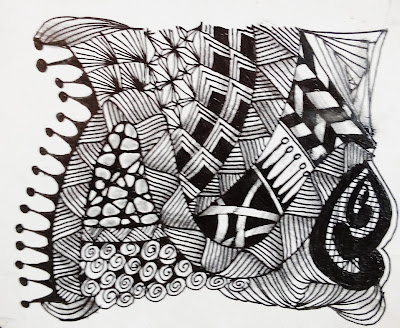
Zentangle is often described as a mindful art practice, but for me, it is much more than creating beautiful patterns on paper.
It is an invitation to slow down.
To breathe.
To pay attention.
To let go of the pressure to be perfect.
And to enjoy the simple act of creating.
At Siloam, where participants spend time exploring inner change, relationships, leadership, peacebuilding and diversity, Zentangle naturally becomes another way of practising these values.

There is no requirement to be an artist. In fact, many participants begin by saying, "I can't draw."
That is usually the perfect place to start.
I remind them that Zentangle is not about drawing something perfect. It is about taking one stroke at a time and being present with what is happening in that moment.

One Line at a Time
There is something beautiful about watching a group of people begin a Zentangle workshop.
At first, there may be hesitation. People look at their blank paper and wonder what they are supposed to create.
Then someone makes the first line.
Another follows.
Soon the paper begins to fill with patterns.
The room becomes quieter.
People become more focused.
And slowly, strangers begin to connect.
For me, this is where Zentangle meets the spirit of Siloam.
We all begin differently, but we can create something together.
Every person's pattern is unique. There is no need for everyone to draw the same thing. In the same way, the participants at Siloam come from different cultures, communities, faiths and life experiences. Their differences do not have to separate them.
They can become part of something larger.


A Different Way of Listening
One of the strongest connections between Zentangle and the Siloam Dialogue is listening.
Siloam encourages participants to practise Inner Listening—to become quiet enough to hear their own thoughts, conscience and deeper sense of purpose.
Zentangle creates a similar space.
As the hand moves across the paper, the mind begins to settle. We stop rushing towards the next thing. We become aware of the present moment.
Sometimes, in that quietness, we notice things that we had been too busy to hear.
That is why I see Zentangle not simply as an art activity, but as a practice that can support reflection, mindfulness and self-awareness.


Connecting Across Cultures
Over the years, I have had the privilege of doing Zentangle workshops with participants from different parts of Northeast India and other parts of the country.
Each group brings something different.
Different ways of seeing.
Different stories.
Different cultural backgrounds.
Different personalities.
Yet, when we sit together with a pen and paper, many of those differences become less important.

We are simply people creating together.
There is something powerful about that simplicity.
In a Dialogue that seeks to build a "Wider Common Stability," these small moments of connection matter.
Peacebuilding is not always about having a big conversation or finding a big solution. Sometimes it begins with sitting beside someone, sharing a quiet moment, and discovering that you have more in common than you thought.

After practising and teaching Zentangle for many years, I continue to discover new lessons through it.
It has taught me patience.
It has taught me to accept imperfection.
It has taught me that small steps matter.
It has taught me to trust the process.
And perhaps most importantly, it has reminded me that creativity can bring people together.
These are also qualities that I see at the heart of Siloam.
The Dialogue asks us to look within, question ourselves, listen to others, heal relationships, embrace diversity and take responsibility for the communities we belong to.
Zentangle offers a quiet way of practising some of those same principles.

A Privilege I Continue to Cherish
Being part of Siloam for more than a decade has been a great privilege.
I have watched participants arrive as strangers and leave as friends. I have seen difficult conversations become opportunities for understanding. I have witnessed people discover the courage to apologise, forgive and change.
And every year, I feel fortunate to contribute in my own small way through Zentangle.
For me, the workshop is never just about what participants create on paper.
It is about the conversations that happen before and after.
It is about the laughter.
The silence.
The curiosity.
The connections.
And the small moments when someone looks at their finished piece and says, "I didn't know I could do this."
Perhaps that is the real beauty of Zentangle.
It reminds us that we are capable of creating something meaningful one small step at a time.
And perhaps that is also the spirit of Siloam.
One person listening.
One relationship healing.
One connection forming.
One small change becoming part of a wider common stability.
After more than ten years, I am still grateful to be part of this journey—and especially grateful that I can continue to share Zentangle along the way.

Comments
Post a Comment